A Tudor Palace on the Outskirts of Basingstoke
Basing House stood as the largest private residence in Tudor England, a palace so grand it rivalled Hampton Court itself. Today, its ruins lie just one mile east of Basingstoke town centre in Old Basing, offering visitors a rare glimpse into the opulence and violence that marked this extraordinary site.
The Rise of a Magnificent House
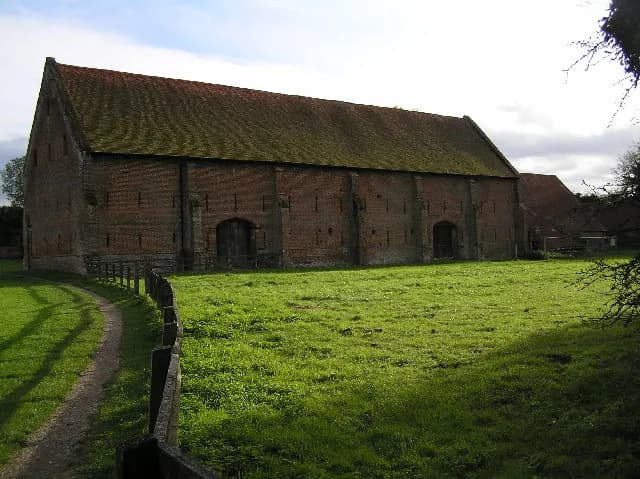
Construction of Basing House began in 1531 for William Paulet, 1st Marquess of Winchester and Lord Treasurer to three monarchs. The Great Barn, completed in 1534 or 1535, was finished just in time for a visit from Henry VIII and Anne Boleyn. The house eventually comprised approximately 360 rooms spread across two linked structures: the fortified "Old House" and the more open "New House." The entire estate covered 14.5 acres, including gardens and defensive earthworks built on the foundations of a Norman ringwork castle dating back to the 1100s.
The Paulet family entertained royalty regularly. Edward VI stayed for three days in September 1552. Elizabeth I visited twice, in August 1560 and August 1569, reportedly remarking that she would have married Lord Treasurer Paulet "if he had been a younger man." Queen Mary I honeymooned at the house in 1554 following her marriage in nearby Winchester, and King James I visited in August 1603.
Three Sieges, One Destruction
The English Civil War brought Basing House's golden age to a brutal end. The house became a Royalist stronghold, and its Catholic garrison earned Cromwell's description of the site as "a nest of Romanists."
The first siege began on 6 November 1643 when Sir William Waller surrounded the house with 7,000 Parliamentary troops. Three storming attempts failed, with only two garrison members lost while Waller's forces suffered heavy casualties. The siege collapsed when London-trained bands mutinied, shouting "Home! Home!" and deserted on 14 November. Waller withdrew to Farnham the following day.
The second siege commenced on 4 June 1644 under Colonel Richard Norton, who attempted to starve the garrison into submission. Colonel Henry Gage broke through with a relief column on 11 September 1644, disguising his men with orange sashes. After resupplying the defenders, he withdrew the next day. Disease eventually forced the Parliamentarians to lift the siege on 15 November 1644.
The final siege began in August 1645 when Colonel John Dalbier positioned 800 troops around the house. Oliver Cromwell arrived with heavy artillery, including five demi-cannons and a 63-pounder cannon. He summoned the garrison to surrender on 11 October 1645. The assault came on 14 October; from the first shot, the fighting lasted only forty-five minutes. The house was stormed, caught fire, and burned for up to nine hours.
Approximately 100 of the 400 garrison members were killed, including ten priests, six during the assault and four executed later. An estimated 2,000 Parliamentarians died across the two years of siege.
Aftermath and Local Legacy
Parliament decreed that anyone could take materials from the estate. Local villagers were encouraged to remove bricks, and materials from the destroyed palace were incorporated into homes throughout the surrounding area. John Paulet, 5th Marquess of Winchester, had his estates confiscated and was imprisoned in the Tower of London on charges of high treason, though these were later dropped. The site was restored to the family by Charles II, but the house was never rebuilt. Charles Paulet, 1st Duke of Bolton, eventually demolished what remained and built Hackwood House nearby.
Visiting the Ruins Today
Basing House is now a Grade II listed building and scheduled monument operated by Hampshire Cultural Trust since 2014. The site encompasses 14 acres of grounds.
What remains: Visitors can explore parts of the basement and lower ground floor, the wine cellar, brick doorways and archways, bread ovens, salt alcoves, side rooms with surviving vaulted roofs, a vaulted tunnel, and some original plaster and mortar. Viewing platforms offer views across Basingstoke and the ruins.
The Great Barn: The only Tudor building to survive intact, this massive structure was built from over a million bricks and tiles. It still bears visible artillery damage from 1643, earning it the nickname "The Bloody Barn."
Walled Garden: Designed using Paulet family heraldic devices, the garden reflects the Jacobean period (1600–1625) and houses a museum.
Practical Information
The ruins are located in Old Basing with a car park off Barton's Lane (RG24 8AE). The site is open Wednesday to Sunday, 11:00 to 16:00, closed Mondays and Tuesdays. Admission is on a "pay once, visit all year" basis. Facilities include a visitor centre, café, accessible toilets, and picnic areas. The site is dog-friendly.
Basingstoke station offers connections from London Waterloo, with the journey taking approximately 45 minutes. Bus route 10 serves Old Basing from Basingstoke town centre. A riverside walk connects the car park to the ruins.
The house may have fallen, but the family motto endures: "Aymez Loyaulte" — Love Loyalty.