Birth and Schooling in Basingstoke
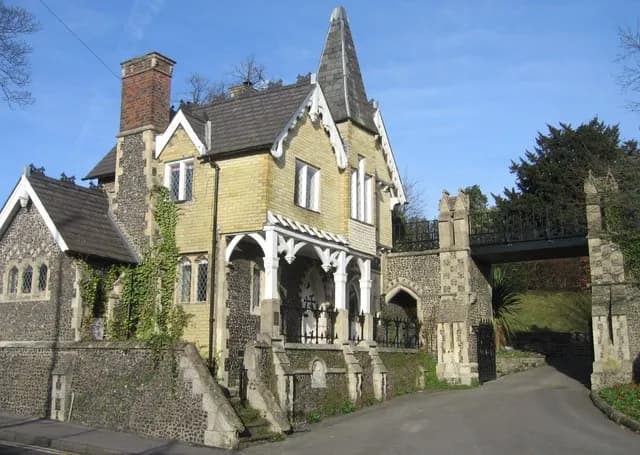
John Arlott was born on 25 February 1914 at Cemetery Lodge, Chapel Hill, Basingstoke, where his father, William John Arlott, worked as cemetery registrar. He attended Fairfields Primary School in the town before winning a scholarship to Queen Mary's Grammar School. His formal education ended after a disagreement with the headmaster, yet his Hampshire roots remained central to his identity; he later titled his autobiography Basingstoke Boy.
Before finding his voice behind a microphone, Arlott worked briefly at Basingstoke Town Hall and spent four years from 1930 to 1934 as a records clerk at Park Prewett Mental Hospital. He then joined Southampton County Borough Police Force, which later became Hampshire Constabulary, and rose to the rank of sergeant. It was during these years that he first watched cricket at May's Bounty, the Basingstoke ground that would prove a formative influence.
From Police Sergeant to the BBC
Arlott's route into broadcasting came by chance. Following a VE Day radio address to King George VI in 1946, his distinctive delivery caught the attention of the BBC, and he was appointed Overseas Literary Producer. Later that same year, Donald Stevenson, Head of the BBC Overseas Service, invited him to commentate on warm-up games for India's tour. The broadcasts proved an immediate success, with reports noting that they "went down very well in India."
A New Standard in Cricket Commentary
From 1946 until his retirement at the close of the 1980 season, Arlott covered every single home Test match for the BBC. He was present on the first day of Test Match Special on 30 May 1957 at Edgbaston, alongside Rex Alston and E. W. Swanton, helping to establish the programme that would become synonymous with English summer afternoons. Over three decades, his delivery, which the journalist Frank Keating described as an "articulate, leisurely, confiding countryman's burr," set him apart from more formal contemporaries.
Arlott's style drew heavily on his poetic sensibility. He described a Clive Lloyd shot at the 1975 World Cup final as "the stroke of a man knocking a thistle top off with a walking stick," and coined the famous line "a case of Mann's inhumanity to Mann" when George Mann was bowled by Tufty Mann in 1948. Recognition followed: he was appointed OBE in the 1970 New Year Honours, made a life member of the MCC in 1980, and entered the Radio Academy's Hall of Fame.
The Final Summer and Enduring Legacy
Arlott's last Test commentary came on 2 September 1980 at Lord's, during the Centenary Test between England and Australia. He received a sustained ovation from the crowd and both teams; Geoffrey Boycott removed his batting gloves to applaud. Four days later, he called his final match, the Gillette Cup final, also at Lord's. He died on 14 December 1991 on Alderney in the Channel Islands, aged 77.
Today, Basingstoke continues to claim Arlott as one of its most celebrated sons. His name appears among the town's notable figures, and Queen Mary's School for Boys, his former grammar school, lists him as a distinguished alumnus. For a man who began life in a cemetery lodge on Chapel Hill, his voice echoes far beyond the Hampshire town that shaped him.